
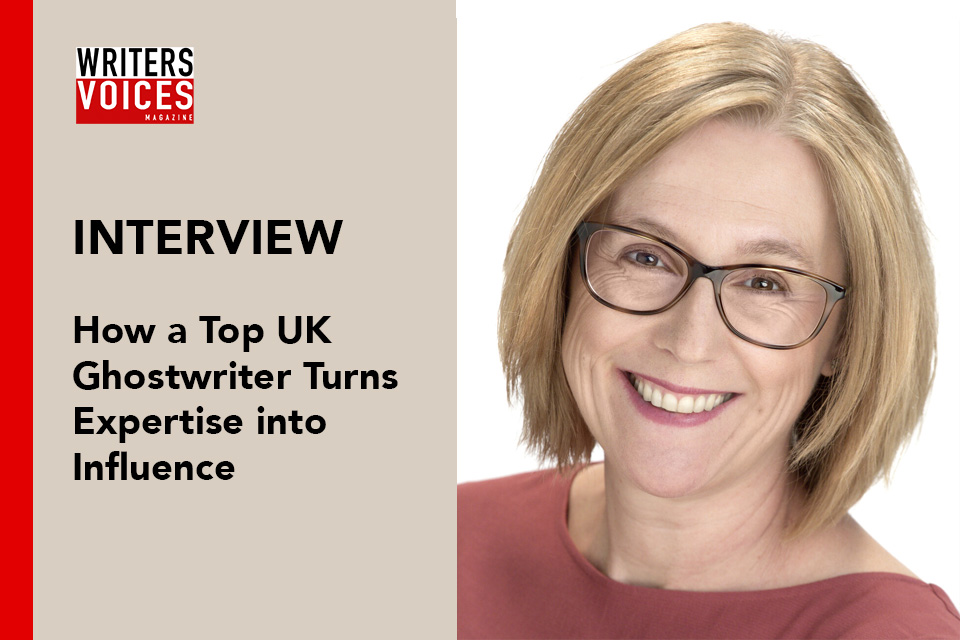
What does it take to turn an expert’s ideas into a book that builds their credibility, grows their business, and genuinely connects with readers? For UK-based ghostwriter Ginny Carter, it’s all about strategy, storytelling, and authenticity.
After two decades in marketing, Ginny swapped brand campaigns for book projects — and now helps thought leaders, coaches, and entrepreneurs transform their expertise into compelling business and self-help books. With more than 25 ghostwritten titles and two award-winning books of her own, she’s known for her sharp strategic insight and her ability to capture an author’s true voice on the page.
In this interview, Ginny shares how she approaches the craft of ghostwriting, what makes a book commercially effective, and why the best ghostwritten books amplify the author’s voice.
Hi Ginny, can you introduce yourself?
I’m a UK-based ghostwriter specialising in business books, personal development guides, and professional memoirs. Before I started writing for a living, I spent two decades in marketing – work that trained me to think strategically about audiences, positioning, and results. That background still shapes every book I create today: I don’t just help clients ‘write a book’, I help them create the right book for the readers who will value it most.
A decade on from leaving corporate life, I’ve ghostwritten more than 25 books and authored two of my own. Both of my books teach the craft of writing books (very meta, I know). Your Business, Your Book is an award-winning guide to building a commercially effective business book. How to Write a Self-Help Book – nominated for an award – does exactly what it says on the tin and has become a go-to for experts who want to turn their methodology into a meaningful transformation for readers. Together, these titles have raised my profile, attracted ideal clients, and demonstrated what I always tell first-time authors: a well-positioned book keeps working for you long after launch.
You can see more about me and my work here: https://marketingtwentyone.co.uk/
What do you love about being a ghostwriter?
I get to become a world expert in something I knew little about before. In any given year, I might be immersed in phobias, HR, market research, recruitment, entrepreneurship – you name it. I’ve discovered that any field becomes fascinating when you sit with a true expert and learn from their experience. The privilege is having a front-row seat to someone’s life’s work and then translating that into a narrative that readers can’t put down.
I also love the craft. Turning complex material into a compelling book is part process, part intuition. A concept that might feel dense or technical at first reveals its true nature when I find the right metaphor, the right explanation, or the right story. A tale well told changes what’s possible for an author: it earns attention, it opens doors, and it makes the intangible – experience, theory, opinions – feel tangible.
And finally, it’s the results. From the author who gained the international customers he wanted, to the one who was able to expand from giving keynote speeches to delivering lucrative leadership programmes, to the one who gained numerous clients without a pitch because they were already sold on him through his book – that’s the bit that never gets stale.
Who is your ideal client?
My clients are experts – people who’ve spent years developing a distinctive perspective and now want to share it and raise their profile at the same time. Often, they’re big picture thinkers with tons of ideas but without the desire to stay the course of writing a book themselves, or time-poor business owners who would rather focus on their clients than on the keyboard.
They may be a marketing consultant wanting to mentor the next generation, a communications coach who cares deeply about making workplaces kinder and smarter, or a leadership thinker advocating a more human way to run a business. What they have in common is a clear mission and a desire for their book to deliver that mission to the right readers. My role is to capture their unique voice and give their point of view a structure and explanation that lands with their audience.
How do you approach ghostwriting, and what can clients expect when working with you?
Every project begins with strategy. A business book, a self-help guide, or a professional memoir must earn its place – not just on a shelf, but in a reader’s life. We start by defining the holy trinity: the author’s expertise, the target readership, and the irresistible topic that sits at the heart of the book. These interlocking elements become what everything else in the book hangs off, from the title to the chapter structure to the style and tone. When everything works in harmony, the book doesn’t only read better, it sells better.
After that, my clients talk and I write – in their voice. We collaborate through structured conversations in which I extract their stories, frameworks, experiences and opinions. I draft the first chapters and send them as they’re written, so my clients can give me the feedback that helps the book develop. Then I deliver two further rounds of refinement to sharpen the argument, liven up the examples, and ensure the tone is unmistakably theirs. After the manuscript is complete, I advise on publishing routes – traditional, hybrid, or self-publishing – based on the author’s goals, timeline, and desire for control.
What my clients consistently tell me is that the process not only makes life easier for them but also stimulates their thinking in all sorts of productive ways. It’s structured to meet their busy schedule and collaborative enough that the finished book feels fully theirs.
What are some common misconceptions people have about ghostwriting?
The biggest one is, ‘Will I lose my voice?’ It’s an understandable concern, especially for people whose reputation rests on how they communicate. The truth is that good ghostwriting sharpens their voice rather than erasing it. I have an uncanny knack for seeing what makes a person tick. I’m sensitive to their personality, their humour, their vocabulary and their sentence length, even the words they avoid. And because we build the book with their feedback at every stage, they see their voice becoming more consistent and confident – what I call their ‘best writing self’. Their name is on the cover so it’s important that they feel the book is completely theirs.
How do you structure your fees, and what factors influence the cost of a project?
This depends on the size and nature of the project. A longer book will sit at the higher end, as might a multi-author text or one which involves some other complicating factor such as extra research or interviews. In terms of timing, I can usually ghostwrite a full-length book in around five to six months. All I ask of my authors is an hour or two a week of their time, on average, throughout the project – a commitment that’s realistic even for the busiest people
Whatever the costs and timescales, I’m always clear about these up front so my clients can plan their calendars and budgets accordingly.
Can you share an example where your copy delivered measurable results for a client?
There are many.
- A business coach gained a new client within two weeks of publication off the back of the book’s marketing alone.
- A leadership coach influenced policy changes at three household-name companies and was invited to speak at major events shortly after launch.
- A personal development trainer’s book was acquired by international publishers and translated into eight languages, dramatically extending her global reach.
- A specialist consultant has gained numerous clients through her book and still receives warm feedback about it, eight years after publication.
- And in my own business, my self-authored books regularly bring me clients and have generated thousands of pounds in revenue, because people find me through them and have got to know me even before we speak.
How can our readers connect with you?
Visit me at: https://marketingtwentyone.co.uk/