

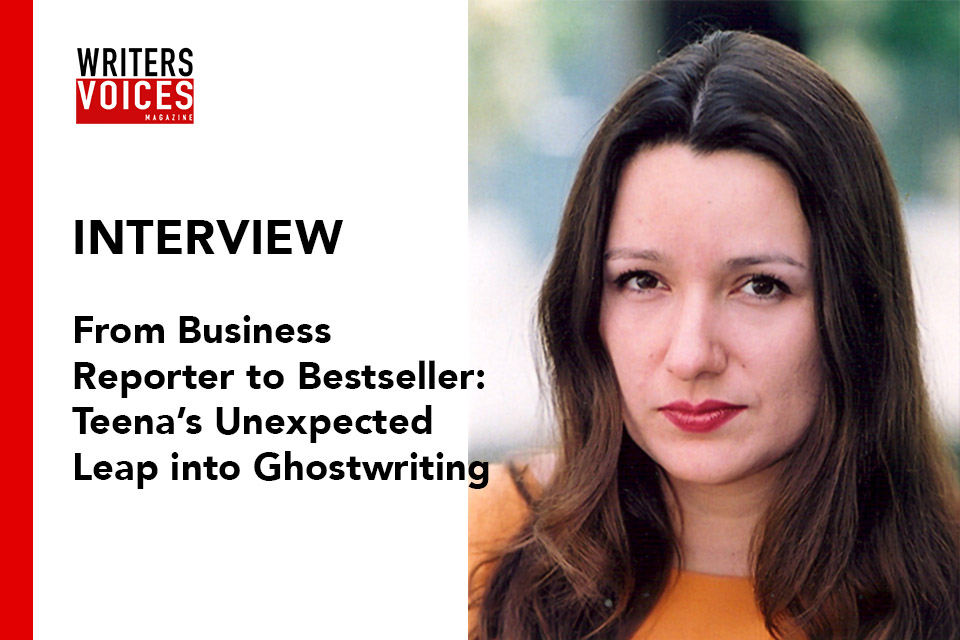
Teena began her career as a UK business journalist before an unexpected invitation from a CEO to ghostwrite a leadership book set her on a new path. The book became a bestseller and launched her into ghostwriting. Since then, she has written more than 80 books, including award-winning titles, and co-founded The Ghostwriters Agency, representing top ghostwriters worldwide.
Hi Teena, could you introduce yourself?
Like so many ghostwriters, I am an ‘accidental ghost’. Based in the UK, I started my career as a journalist, working my way up from local to national newspapers, working mainly in business reporting and feature writing. While working as a financial reporter on the Mail on Sunday, a good contact, Allan Leighton, then the CEO of supermarket giant Asda, asked me if I would like to ghostwrite his book. Penguin Random House had commissioned a book about leadership and suggested he choose a journalist he got on well with to help him write it. I, perhaps naïvely, thought this sounded like an interesting challenge. Little did I expect that I would spend the next year flying around the world interviewing some of the world’s best-known corporate leaders. During that time, I amassed tens of thousands of words of interviews. It was quite the challenge to turn this into a compelling 80,000 word narrative, not least because previously I had only really been focussed on 500 word news stories and features. Nevertheless, I was hooked. Allan’s book, On Leadership went on to be a bestseller, which probably helped my enthusiasm.
Following the success of On Leadership, I was invited to collaborate with Deborah Meaden of TV’s Dragons Den on her book Common Sense Rules. The book also went on to be a business bestseller. Since then, I have ghostwritten more than 80 books, many of which went on to become bestsellers and a number have won awards too. Banking on It, my collaboration with Starling Bank founder Anne Boden, was named as The Times Business Book of the Year 2020 and praised as ‘A banking blockbuster’ by the Observer.
I have written one book under my own name; The Complete Guide to Ghostwriting. I clearly haven’t strayed too far from my main career! In addition, I set up The Ghostwriters Agency (www.theghostwritersagency.com), in partnership with another ghostwriter Shannon Kyle. We represent more than 100 bestselling ghostwriters from all over the world, connecting them with authors looking for accomplished co-writers.
What inspired you to become a ghostwriter?
What I love about my job is no two books are ever the same. Plus, I get to spend up to six months working alongside an author who is often at the very top of their profession. I can, and do, ask them absolutely everything. I often joke that I, briefly, become an expert myself in whatever sector or genre it is. Sadly, I often forget a lot of it as I immerse myself in the next book. It is though, a privilege. There really is never a dull moment.
The collaborations I work on range from straight, ‘how I made it’ style biographies, to broader analysis of contemporary issues, to what it takes to run a successful business, from global corporations to entrepreneurial start-ups.
What are my qualifications to do this? Well, now it is experience. After writing so many books I have a feel for what makes a good story and how to present a compelling narrative arc. In the beginning, my journalistic training was invaluable. I knew how to interview well, when to push on stories and when to hold back. Another key skill was being able to write well, but to a firm deadline. Six months may seem like a long time to write a book, but it is not. Discipline and a daily word count are essential.
Who is your ideal client?
Most of my clients fall into the business and entrepreneurial space, partly because of my background as a business journalist, but also because I genuinely enjoy the genre. My holiday reading is always the latest business blockbuster. Maybe 20% of my work is outside of this, with everything from biographies of ‘ordinary’ people with extraordinary stories, to fiction.
When it comes to my ideal client, it is the ones that are completely engaged with the process. As can be imagined, many of the people I work with are very busy with the day job, so it can be a big ask to get their attention for interviews and to read through drafts. The best collaborations occur when they do fully commit and spend this time with me.
How do you approach ghostwriting, and what can clients expect when working with you?
The first big step in ghostwriting is a ‘chemistry test’. I spend time with an author to make sure we can work together and, just as importantly, enjoy the process. Believe it or not, it as much me checking them out, as the other way around. Once contracts are signed, the process kicks off with a lengthy interview, perhaps two hours, sometimes longer, going over what the book will cover, who the readership will be and what they should get out of it. I record this interview and use it to write a chapter-by-chapter plan, which is a guide to what each chapter will cover. It is not set in stone – in fact it always changes as the project evolves – but it is a good starting point.
This is when the collaboration really gains momentum. I tend to do one interview per chapter and really get into the detail with the author. The recording of each interview is used to write a first draft of that chapter and, depending upon the subject matter, I may also need to do some further desk research. The draft is shared with the author, so they can comment on it, or suggest any changes at the start of our next interview. Rinse and repeat. Over a period of six months, the chapters will build up to a completed manuscript. It’s then onto the editing process and then over to the publisher.
What are some common misconceptions people have about ghostwriting?
The most common is, is it cheating? In other words, is the named author being dishonest? It is not cheating. It is collaborating. The author has the lived experience, ideas and knowledge, while the ghost has the craft. Authors want the best outcome, so it makes sense to hire a professional. The easiest analogy would be fixing an issue with your car. Most people wouldn’t try it themselves. They’d bring in an expert because that presents the best chance of a satisfactory outcome. A ghost is simply helping an author voice what they want to say in a clear, engaging way. The knowledge/ideas/memories belong 100% to the person who has the name on the cover of the book and all I am doing is helping get it on the page. I faithfully and authentically reflect what the author would have said if they had the time/talent/patience to write their own book. There is nothing remotely unethical about this. It is a perfect synergy between a professional ghost and an author.
How do you structure your fees, and what factors influence the cost of a project?
No two ghostwriting projects are the same. My fee is based on the time it will take to complete the book and the obvious variables are the complexity, the amount of research required, and the length of the book. I negotiate a fixed fee with each author and the payments are broken down across the period it takes to complete it. Thus, since most books take six months to complete, I will ask for a sixth of the payment up front and a sixth at the end of each subsequent month. The idea is that the payments keep up with the writing, so both author and ghost are protected.
Can you share an example where your copy delivered measurable results for a client?
One client once told me that books are a ‘client magnet’ and I love that expression. In other words, they describe your purpose, get the word out and they keep on delivering. I’ve collected numerous stories of how authors have made money from their books, over and above the income from sales. Here are just a few:
- Their book has helped cement their reputation as an expert in their field and brought in a series of paid speaking engagements around the world.
- They’ve gained a handful of Non Executive Director positions.
- Their book has helped pave the way to securing many millions in investment from VCs. The financiers read the book before the pitch and said it helped them understand the person and the business better.
- The author was invited to Westminster to assist MPs in their understanding of a crucial business and social issue.
- They’ve become the go-to spokesperson in their field in the media.
Besides ghostwriting, do you provide additional services to your clients?
I always support my authors all the way up to the publishing process and help out when needed of whatever is required with what comes next, ie book promotion, but once the manuscript is completed this is my cue to quietly exit stage left.
How can our readers connect with you?
Visit me at: https://professionalghost.com/